AI returns on earnings calls: a census
60 major US-listed financial firms, 919 earnings calls, Q4 2022 season through Q2 2026 season. One firm has ever stated a realized dollar return from its own AI use. It was not JPMorgan.
SPEC Research analysis of the Maximand Token Tape corpus · Milos Maricic · 25 August 2026 · maximand.ai/token-tape
Findings
1. One firm out of 60, twice, roughly $19 million. The other 59: zero, ever.
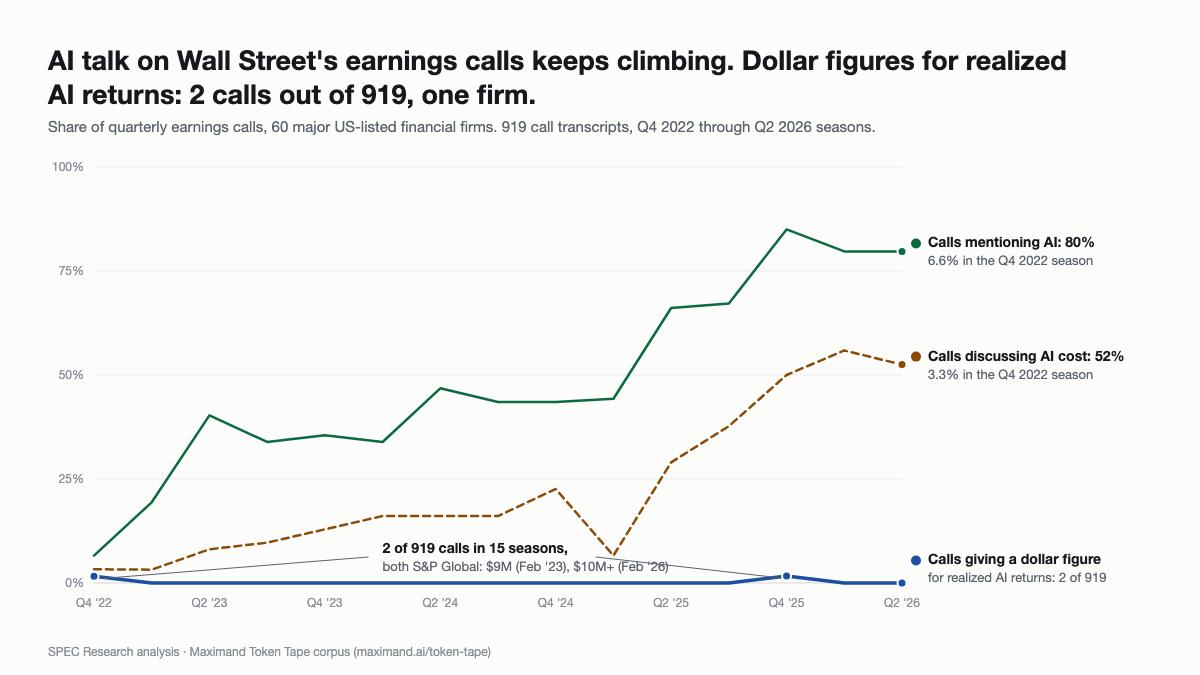
Across 15 earnings seasons and 919 calls, exactly one firm stated realized dollar returns from its own AI use: S&P Global. Its then-CFO said on 2023-02-09 that Kensho Scribe "is saving 250,000 hours of men work per year for transcripts. Annual savings of that are approximately $9 million." Its current CFO said on 2026-02-10, in an answer opening "on the internal usage of AI", that researcher-facing tools have "already been able to simplify, streamline and save $10 million plus over the last year." Combined, about a quarter of one percent of the firm's stated $7.5 billion expense base. Neither figure was ever restated.
Definition applied: a specific dollar amount of savings or revenue that management attributes to the firm's own AI use, already achieved, not bundled inside a broader program. Spending, targets, guidance, and revenue from AI products sold to clients do not count.
2. JPMorgan says $2 billion everywhere except its own earnings calls.
The bank's AI value figure has a three-year public life, all of it outside the earnings call: the May 2023 investor day (CIO Lori Beer raised the "business value" target from $1 billion to $1.5 billion for year-end 2023), the May 2024 investor day (then-President Daniel Pinto: "the value that we assign to our artificial intelligence use cases is around between $1 billion to $1.5 billion"), the September 2024 Barclays conference (Pinto: "this year it's heading more towards $2 billion... a lot of that is related to prevention of fraud"), and Bloomberg TV on 2025-10-07 (Jamie Dimon: "We have shown that for $2 billion of expense, we have about $2 billion of benefit"). Checked against all thirteen official JPMorgan IR earnings-call transcripts, 2Q 2023 through 2Q 2026: the figure was never stated on any earnings call in that span. Mike Mayo asked for returns on the spend on 2024-01-12, 2024-07-12, and 2026-01-13. No dollar answer any of the three times; Dimon's January 2026 reply includes "part of you has to trust me, I'm sorry."
2a. The seven-day juxtaposition.
Dimon states the $2 billion benefit on Bloomberg TV on October 7, 2025. On JPMorgan's earnings call of October 14, 2025, one week later, no figure is given, and CFO Jeremy Barnum says of the alternative approach: "you must prove that you're generating this much savings from AI, which turns out to be a very hard thing to do, hard to prove."
3. The talk keeps climbing while the dollars never arrive.
Calls mentioning AI: 6.6% in the Q4 2022 season to 79.7% in Q2 2026 (peak 85% in the Q4 2025 season). Calls discussing AI cost: 3.3% to 52.5%. Calls stating a realized AI-return dollar figure: 2 of 919 across 15 seasons, both S&P Global, never above $10 million-scale. The larger the claimed number, the further from the earnings call it is stated.
4. Executives are saying on the record that the number cannot yet be given.
- Franklin Templeton · CEO Jenny Johnson, 2026-04-28
- Doubts many companies can yet call AI material to their organization, and declined to share Franklin's own preliminary numbers. CFO Matthew Nicholls said the firm is doing its best to track the dollars it spends against the dollars it saves or gains from AI.
- Citizens · CEO Bruce Van Saun, 2026-04-16
- Asked when banks will be able to tell investors "we just spent $X million on AI, and this is the bottom line impact": "Yeah. I think it's going to be hard."
- AllianceBernstein · Head of private wealth Onur Erzan, 2026-04-28
- After listing the firm's AI deployments, he cannot yet put a number on it, and the visible benefits have "not translated into very concrete financial impact yet."
- KeyCorp · CEO Chris Gorman, 2026-01-20
- "it's early to claim some kind of cost savings."
5. Context.
Goldman Sachs Research (2026-08-14) finds only 2% of S&P 500 companies quantify AI's earnings impact, index-wide and unnamed. This census is the name-level, sector-complete version for finance, where the AI-productivity narrative is loudest: every firm named, every call counted, every candidate sentence adjudicated against a stated definition.
The near-miss roster
Every statement in the corpus a reader could mistake for a realized AI dollar return, with the reason it does not qualify. The strongest first.
| Firm, date, speaker | Statement | Why it does not count |
|---|---|---|
| Progressive 2024-08-06, Dave Krew | Chatbots since 2018 "replaced millions of dollars of human support cost"; personalization "benefits in the hundreds of millions of dollars" | Magnitudes, not specific figures; 2018-era chatbots and decision-science personalization only arguably AI |
| MSCI 2025-10-28, Henry Fernandez | AI data-capture saved "hundreds and hundreds of... new hires... tens of millions of dollars" | Order of magnitude, not a specific figure |
| S&P Global 2025-10-30, Eric Aboaf | AI tools for first drafts of research reports "has already created multimillions of dollars of savings this year" | Order of magnitude, not a specific figure |
| Nasdaq 2026-04-23, Adena Friedman | "striving to achieve $100 million of expense efficiencies by the end of 2027" from AI | A target restated from investor day, not realized |
| S&P Global 2026-07-28, Martina Cheung | EDO "achieved nearly 60% of its targeted $100 million... through a combination of AI-driven efficiencies and traditional productivity initiatives" | Bundled by its own wording |
| KeyCorp 2026-01-20, Chris Gorman | "a call to a call center costs 25 cents using AI. And if a human picks it up, it costs $9" | Per-unit anecdote, no volume; speaker adds "it's early to claim some kind of cost savings" |
| FactSet 2025-09-18, Helen Shan | GenAI product revenue guidance of 30-50bps ASV: "we were exactly in the middle" | Revenue from AI products sold to clients |
| Citizens 2026-04-16, Aunoy Banerjee | "exit 2026 with an annualized run rate of about $100 million of pre-tax benefit" | Expected, and the program is broader than AI |
| Bank of America 2025, Brian Moynihan | "17,000 programmers using AI coding technology today, saving 10% to 15% in cogeneration costs" | Percent only, never a dollar figure |
| Citi 2025-10-14, Jane Fraser | "creates around 100,000 hours of weekly capacity" | Hours, not dollars |
| BNY 2025-01-15, Robin Vince | "approximately $0.5 billion of efficiency savings as we continue to digitize workflows and begin to leverage new technologies, including AI" | Bundled; AI explicitly nascent |
| AIG 2025-08-07, Peter Zaffino | AIG Next "delivered $500 million in savings" | Firm-wide restructuring program; AI one of five initiatives |
| Nasdaq 2025-2026 | Efficiency program "over $150 million" / "over $160 million in cost reduction actions" | Whole-firm program built on deal synergies; AI share never separated |
| Moody's 2025-07-23, Noemie Heuland | "already executed on annualized savings of over $100 million" | Multi-lever program; GenAI one component |
| Moody's 2025-2026, Rob Fauber | GenAI-cohort ARR "approaching $200 million"; "$6 million" and "$3 million" deals; a client's "millions of dollars saved" | Revenue from AI products sold to clients; the savings belong to the client |
| State Street 2026-07-16, John Woods | "approximately $1 billion of run rate transformation benefits by 2029" | Projected and bundled with operating-model reengineering |
| Fifth Third 2026-01-20, Bryan Preston | "value streams reached $200 million in annualized run rate savings" | Broad automation program; AI never named as the source |
| Wells Fargo 2026-01-14, Charles Scharf | "we've cut $15 billion of expenses out of the company", near AI-as-future-tool talk | Multi-year program with no AI attribution |
| MetLife 2024-2026, Michel Khalaf | "$1 billion of expense capacity" freed; expense ratio "aided by AI and other emerging technologies" | Program dollars not AI-attributed; ratio claims bundled, non-dollar |
| BlackRock 2024-2026, Larry Fink | AIP "$12.5 billion" raised; "$30 billion" partnership target | Ecosystem fundraising and client flows, not own-use returns |
| FactSet 2025-2026, Sanoke Viswanathan | "27% of committed code" by coding agents; "10% reduction in our technology workforce" | Percent-only operational metrics |
| Prudential 2023 / 2026 | "$820 million of annual run rate cost savings" achieved; "$750 million... by year-end 2028" | First predates any AI attribution; second projected and bundled |
| Citizens 2026-04-16, Brendan Coughlin | "over $30 million in projected vendor saves" | Projected, and labeled "non-AI based" by the speaker |
| Nasdaq 2024-2026, Adena Friedman | Verafin "90% reduction in alert review time"; "$1 billion of inflows" to an AI-themed ETF | Client-side product benefits; ETP inflows are client capital |
Methodology
Cohort
A fixed 60-name universe of US-listed financial-sector firms as of 2026-07-18: 21 banks, 15 asset managers and alternatives firms, 16 insurers, 8 exchanges and market-data firms. Two names exited during the window by take-private or acquisition and were replaced, with the exited firms' history retained; that retention plus a small number of missing calls is why the corpus holds 919 calls rather than 60 x 15 = 900. Calls are grouped into 15 calendar reporting seasons; firms with off-calendar fiscal years appear under the season in which their call falls.
How the 60 were chosen: the panel covers the main US-listed names in those four segments and was fixed on 2026-07-18 for the Token Tape, a month before this census. It is not a market-cap ranking. Payment networks and conglomerates fall outside the four segments, and Berkshire Hathaway holds no earnings calls. On 2026-10-02 the 45 calls of Visa, Mastercard and American Express over the same window were checked: none states a realized dollar return from the firm's own AI use either.
Pipeline
(1) Keyword scan: sentence-level match on an AI term list across all 919 speaker-attributed transcripts. (2) LLM classification of every matched sentence: false positives removed (crypto tokenization, digital-token custody), each true positive graded for cost versus capability talk and speaker role. 4,162 matched sentences, 156 false positives, 4,006 AI sentences retained. (3) Money sweep: of the 4,006, 63 sentences contain an explicit money figure (a dollar amount, a scaled million/billion number, or basis points); 56 spoken by management, 7 by analysts; every one quantifies spending, guidance, product revenue, or a bundled benefit. (4) Adversarial counterexample hunt (2026-08-24): a deliberately wider net, treating automation, productivity, efficiency, and savings language as money-adjacent and including neighbor paragraphs, produced 1,001 candidate paragraphs, each reviewed against the definition, survivors verified against raw transcripts. The hunt found the two S&P Global instances and nothing else. This layer exists because a dollar figure can carry its AI attribution in paragraph context rather than in the sentence, and both S&P Global instances do.
Quote discipline
Corpus text locates a quote; the quote is verified against the official transcript before use. All JPMorgan quotes are official IR transcript wording. Franklin Templeton material is in indirect speech because no official transcript is available. Vendor-transcript quotes are marked.
Series note
The AI-cost-share line dips in the 2025-Q1 season while the keyword layer shows that season in line with its neighbors. Checked 2026-08-25 by fully reclassifying the season with the identical prompt and model: the result reproduces. That season's cost-adjacent talk is dominated by passing efficiency mentions inside capability answers, which the classifier does not count as cost discussion. Both layers are available.
Data
- The 60 firms · ticker, name, segment (CSV)
- Season-by-season series · calls, AI share, AI-cost share, 15 seasons (CSV)
- The 63 money-figure sentences · firm, date, speaker, role, category (CSV)
- Chart · AI talk against realized-return figures, 1200 x 675 (PNG)
The two qualifying S&P Global statements are not in the sentence file: their AI attribution sits in the surrounding paragraph, which step 4 of the pipeline exists to catch.
SPEC Research analysis of the Maximand Token Tape corpus: 919 speaker-attributed earnings-call transcripts, sentence-level classification, per-quote source verification. The JPMorgan venue record with per-quote source classes and the complete counterexample-hunt record are available on request. This document was prepared on 25 August 2026 and revised on 1 October 2026.